Chinese New Year Celebrations
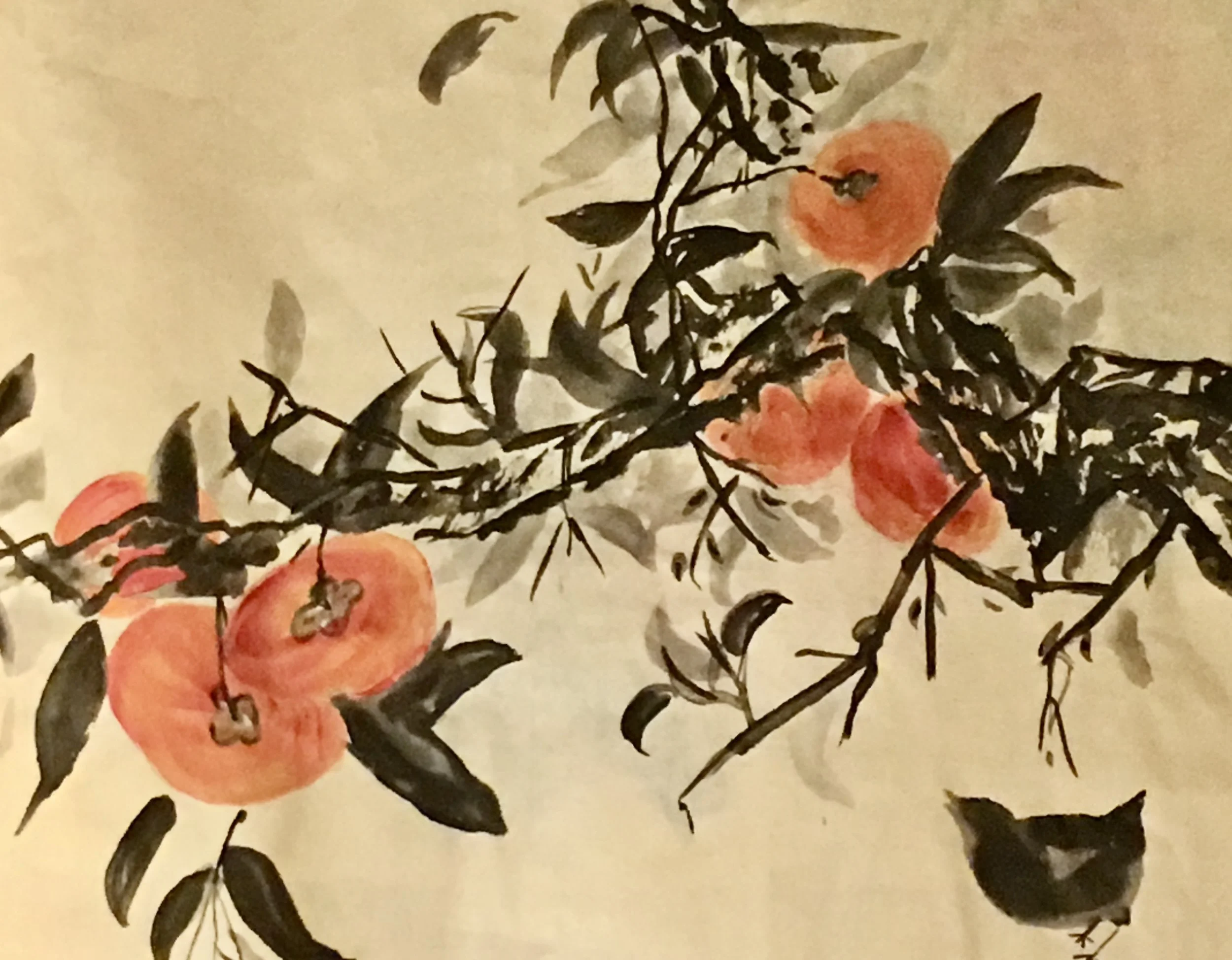
Persimmons Chinese Brush Painting by Sylvia Bennett
It can be confusing that the Chinese year starts on the 4th February, being based on the Solar calendar that is familiar to us, yet it is only rarely celebrated on that day. This is because the celebration of the Chinese New Year, sometimes termed the Spring Festival, is based on the Lunar calendar. It always begins on the second new moon following the Winter solstice, which this year is the 17th February. In other years it would begin some time between the 20th January and 20th February.
Chinese New Year festivities continue for fifteen days, ending at full moon with the Lantern Festival. The first seven days are considered a public holiday, but many people take a holiday break for the full fortnight.
Happy Chinese New Year Customs
For people throughout Southeast Asia, and for Chinese communities and families everywhere in the world, celebrating the Chinese New Year is a very special event. In preparation for the festivities, many traditional customs take place in Chinese households for several days before New Year’s Eve, with fervent activity.
People would go out and buy new clothes to wear for the New Year celebrations, to represent a fresh start and bring the wearer good fortune in the year ahead. Vibrant colours like red, gold, purple and orange are favoured choices to bring luck, wealth and health. Black and white clothes are unpopular, being associated with mourning.
Homes would be thoroughly cleaned and floors swept throughout to banish any bad luck and make way for incoming good fortune. Red decorations would appear everywhere, in rooms, across windows and on doors. The colour red is considered to be a most lucky colour in Chinese culture, and sometimes thought to ward off evil spirits, it represents success, happiness, prosperity and vitality and it dominates everywhere during New Year celebrations.
Chinese New Year's Eve is an occasion for families to gather together for their annual reunion dinner. This huge feast is a noisy, exuberant occasion with much laughter and fun, continuing until firecrackers and fireworks are set off at midnight to scare away evil and welcome in New Years Day. Grown-ups and elders of the family give red envelopes, filled with ‘lucky’ money to the children and unmarried young relatives as a symbol of good fortune. These family festivities continue for at least the next two days during the holiday.
New Year’s Day is typically a time for visiting senior relatives of the family and close friends, always bringing auspicious presents and exchanging good wishes. Visitors never come empty-handed. They would usually bring festive gifts that represent abundance and positivity for the recipients, especially persimmons and mandarins or oranges, tangerines, satsumas and kumquats, because they represent ‘lucky gold wealth’, also food hampers and sweet delicacies that symbolise enjoying a sweet life.
The lively Lantern Festival signals the final celebration of the Chinese New Year. Streets are brightly decorated to symbolise good luck and animated dragon and lion dance parades are performed to bestow blessings and prosperity on the crowd around them. During the evening many floating and flying lanterns are released and noisy fireworks are set off to drive out the past year and welcome in the new year.
Welcoming 2026 with Chinese New Year Customs
New Year means new beginnings and letting go of things that don't work for you any more or have become surplus. Get rid of the old and make space to bring in new energy. Start by clearing out old clutter. Discard old food, unloved clothing and everything else that is no longer cherished or needed.
Spring clean everywhere, including inside cupboards, drawers and ledges. Play music and dance to uplift and enliven the atmosphere in your home with joy and fun. Open your windows wide to welcome in a new breath of fresh air.
- Get a new door mat - this symbolism to make a positive fresh start to the year can become reality. And it will smarten up your entrance area!
- Do something different. It invites in positive new energy. For example, take a different route to work, get a new hairstyle, explore new places and fresh opportunities. Whatever you do, do it with positive intention. Even making a small change will have a big impact.
- Wear something red because the colour red is auspicious and is considered to fend off ill fortune. Its element is Fire, characteristically it is illuminating, passionate and successful.
- Place a large bowl of citrus fruit or a vase of red flowers on the dining table to represent renewal, growth and abundance in every aspect of your life.
A thoughtful Chinese tradition at New Year is to reconcile differences, forget past grudges, reunite and sincerely wish peace and happiness for others. Restoring harmony is a fundamental of Feng Shui and it feels good to patch up misunderstandings. At least give it a go, you may be agreeably rewarded by the outcome.
Wishing you peace, abundance, health and joy during the Chinese year of the Fire Horse 2026.
Warm wishes
Sylvia
Sylvia Bennett
Accredited Feng Shui Master
Architectural Design Consultant
Holistic Therapist
+ 44 (0)7779 139187